Even after the flap buckle is released, the camera remains behind a separate zipper. Fast street photography brings attention to that entire route, from the worn position of a camera sling bag to its internal storage. The route is complete only after the equipment has a place again and both openings have been reclosed.
Position the Bag Before Opening It
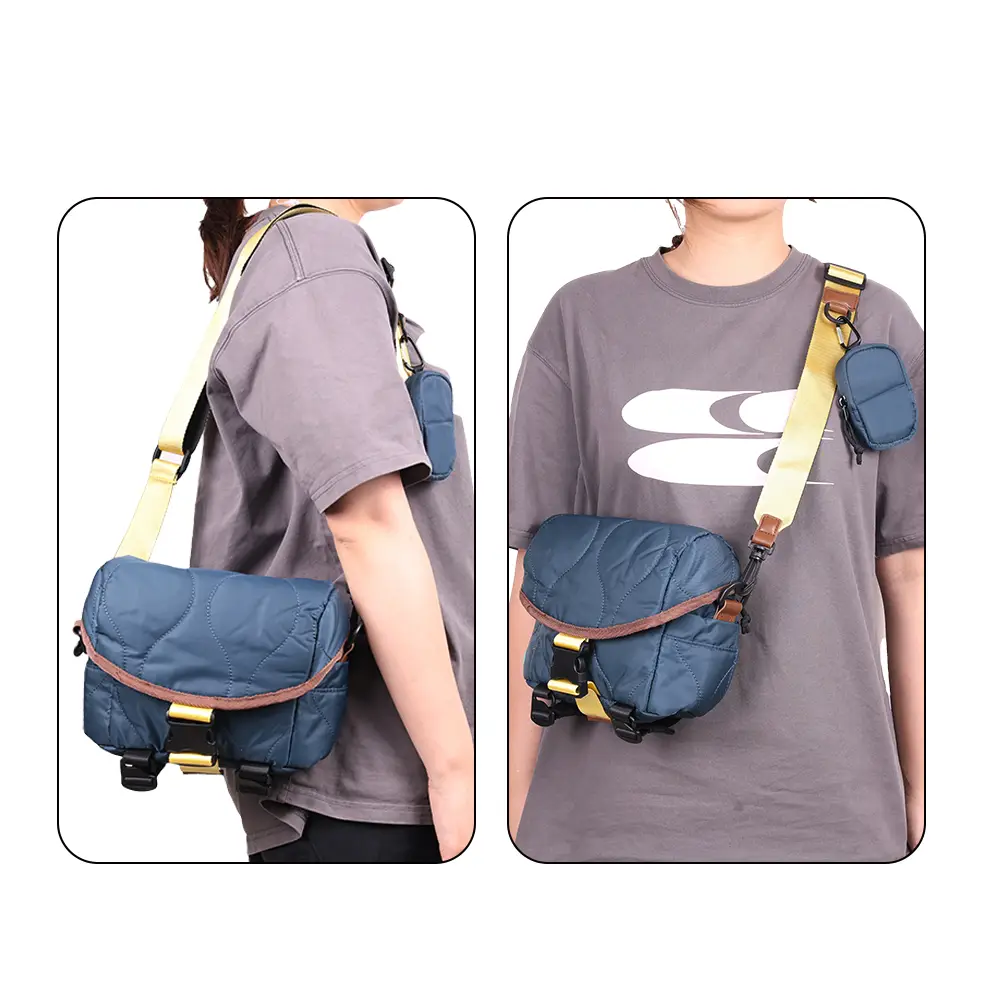
Distance between the hand and the opening changes with the carrying position. An adjustable strap gives shoulder and crossbody configurations a way to be considered against the intended access. The position of the bag, its opening and the hand belong to the same practical question, even before either closure is released.
An urban camera bag also carries belongings that may be needed separately from the camera. Assigning those items distinct locations can keep their retrieval independent of the main compartment. A phone or other personal essential can be kept separate from the camera retrieval task, provided its intended storage position supports that separation.
Strap length and bag position need review with the proposed contents inside. An empty shell cannot represent every relationship created by a packed compartment. The useful observation concerns whether the opening remains accessible in the selected carrying position and how the person reaches it, without assuming that shoulder and crossbody use create identical movements.
Placement can be considered before adding more pockets or changing a closure. If the starting position makes the opening awkward to approach, an additional compartment may leave the underlying relationship unresolved. Access design therefore begins outside the bag, with the position from which the hand approaches the flap and the equipment space behind it.
Work Through the Two Closures
ChangRong’s CXN1154 closes with a central quick-release flap buckle above a separate main zipper. The first closure secures the flap, while the second controls entry to the camera compartment. Releasing one does not remove the other from the sequence. Their combined arrangement provides a concrete example of why access needs to be understood step by step.
Our compact model measures 21 × 9.5 × 18 cm and belongs to the Functional Transform Series. Wear-resistant nylon, quilted padding and an orange-lined interior form part of its construction. A padded central divider separates the interior. In this camera sling bag, the access route continues beyond the zipper to the particular storage area holding the equipment.
An urban camera bag can make that internal route more understandable through separation. A defined area for camera equipment and another for accompanying belongings gives each retrieval a clear destination.
The divider provides a physical boundary; the packing arrangement supplies its purpose. The two need to be considered together when deciding what the hand must pass to reach the intended item.
Small exterior side pockets, a broad rear slip pocket and a compact zippered pouch on the carrying strap offer other storage locations. The adjustable strap attaches with clips, and two webbing straps run underneath the bag. Each detail occupies a different position relative to the main opening, so its role in access depends on the belongings assigned to it.
Consider a proposed arrangement with the camera in one divided area and personal essentials in exterior storage. Reaching a small item would then involve its own opening, while camera access would still pass through the flap and main zipper. Comparing those routes with the same contents makes the effect of a pocket location easier to discuss without confusing it with the number of items being carried.
Include Return and Closure in the Access Route
Putting the camera away retraces some actions while adding the need to restore the packed arrangement. Equipment has to return to its intended area before the main opening is closed. The flap and its buckle then form another closure task. A design concerned only with opening would leave this later part of carrying unexplained.
The camera sling bag can be reviewed as a continuous cycle of approach, opening, retrieval, replacement and closure. Internal divisions matter during replacement as well as retrieval: they distinguish where the equipment belongs after use. Exterior storage can keep unrelated small items outside that task, with their own openings considered independently from the main compartment.
We customize CXN1154’s structure at ChangRong, with color, fabric and logo options. Changes to the layout can be discussed in terms of this cycle: which belongings use the main opening, which occupy exterior storage and how the arrangement is restored after photography. The discussion stays attached to identifiable access tasks instead of adding features without a defined purpose.
The same lightweight model serves photography, ordinary outings, commuting and travel. Those settings can involve different combinations of equipment and personal essentials. A compact carrying setup may place more emphasis on one internal area, while another arrangement uses the exterior pockets more actively. The access route needs to be read against the particular contents, not an assumed universal packing list.
Opening and repacking belong to one design question in an urban camera bag. ChangRong brings the flap, zipper, divider and external storage into that relationship through our existing structure and customization options. The access cycle ends with the camera returned to its place and the main zipper and flap buckle closed again.