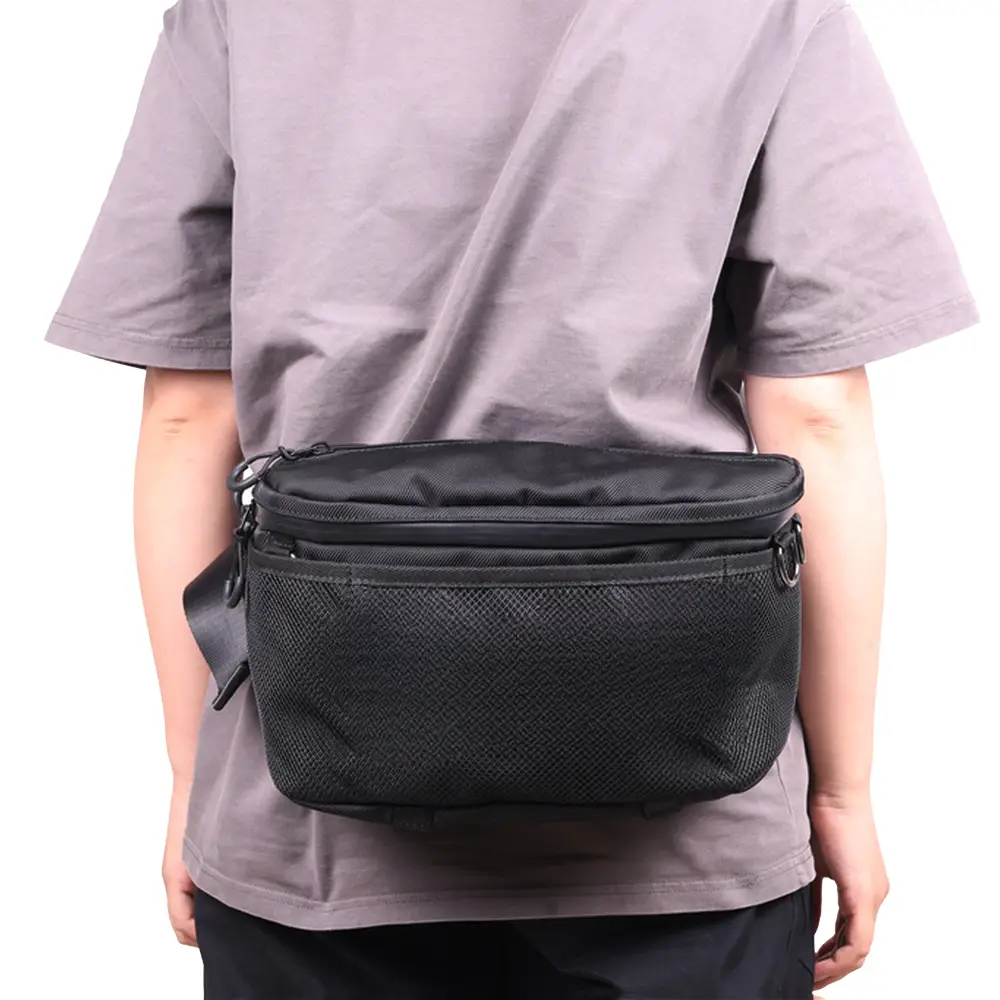
A lid pocket, divided main storage and a front mesh pocket occupy different positions on the same tackle bag. These storage locations belong to our shoulder-carried ChangRong CXN1152, measuring 31 × 14 × 18.5 cm and designed for fishing tackle, tools and personal items. Planning a fishing tackle storage bag for a cool-weather outing can begin with that existing architecture, before particular groups of belongings are assigned to it.
Map the Existing Storage Architecture
The zippered lid sits above a main storage area containing internal partitions. A mesh pocket lines the inside of the lid, while a large mesh pocket spans much of the front exterior. These are distinct locations, even though they belong to the same compact body. Their positions establish the available relationships between the main compartment, lid and front surface.
Internal partitions give the fishing tackle bag boundaries within its main storage area. The lid pocket creates another location above that area when the bag is open. Exterior storage occupies a different plane again. Reading those positions first makes it possible to discuss a layout with named areas, rather than describe organization only as a general benefit.
The shoulder strap adds a carrying relationship to this spatial map. It is adjustable, has a padded shoulder section and connects through rings at the sides of the bag. The lid and exterior pocket therefore need to be considered as parts of a shoulder-carried arrangement, with the intended contents providing the context for access.
Read the Lid and Exterior as Separate Spaces
Opening the lid changes which parts of the storage can be approached together. The main area and the mesh pocket inside the lid form different surfaces around that opening. Their relationship is relevant to a task involving several belongings, because the contents may be distributed between the divided base and the lid above it.
The front pocket remains an exterior location in the fishing tackle storage bag layout. Its position can be considered separately from the internal partitions and lid mesh. A proposed item assigned to that front area therefore has a different storage relationship from one placed inside, even before any judgement is made about how frequently it will be needed.
Pocket position alone does not settle what belongs there. A proposed load needs to be considered against the actual openings, available space and intended tasks. The external dimensions provide a physical reference for that discussion, while the internal divisions describe how the space is organized. Neither replaces a review of the belongings planned for the particular trip.
Assign Tackle Groups to Defined Areas
Task groups can now be assigned to the established fishing tackle bag areas. Tackle needed together can form one group, tools another and personal belongings a third. The purpose is to give a group a specific location within the known architecture. The arrangement can then be examined for tasks that would require access to more than one area.
If a task involves tackle and a tool, assigning them to different areas does not automatically make the arrangement unsuitable. The relevant question is whether the two locations make sense together when that task is performed, with the lid and strap arrangement considered.
In ChangRong’s CXN1152, the divided main area, lid mesh and front mesh provide the actual positions for that discussion. We can relate a proposed grouping to those features without assuming that every outing has the same contents. Lake and river trips, including freshwater and saltwater fishing, are among the model’s intended applications, leaving the particular load to the planned outing.
For a cool-weather kit that includes gloves, their proposed location belongs in the personal-item discussion. Their position can be reviewed alongside the chosen personal items. The important relationship is whether their placement leaves the intended tackle and tools in their assigned areas. Changing the proposed load therefore gives the layout review a different set of belongings to accommodate.
Resolve the Gaps in the Layout
An unassigned task reveals a specific gap in a fishing tackle storage bag plan. The gap may concern the boundary between groups, the location of a particular item or the relationship between the lid and a storage area. Naming it makes a structural discussion more precise than asking generally for additional organization or more pockets.
The physical arrangement remains the starting point for any proposed CXN1152 structural customization. A proposed layout change can begin with the task that remains unresolved, then identify the existing area that would be affected. The point of that discussion is to connect a modification with a use, while retaining a clear account of the original model’s storage arrangement.
The final packing review can return to the areas already mapped: main storage, internal partitions, lid mesh and front mesh. Each task group needs an identified destination, including the personal belongings added for the particular outing. A remaining uncertainty about where a group belongs is more useful as a design input than a broad claim that the bag needs improvement.
Any task still without a clear location deserves attention before the layout is settled. That unresolved task can shape the ChangRong structural customization brief for our fishing tackle bag. Organization is complete at the practical level when the belongings needed together have an assigned place within the arrangement being considered.