Sweat buildup against the back is not simply a fabric problem. A backpack can use breathable mesh and still feel hot if its cushioning presses flat against the wearer and blocks air movement. Molded foam backpanels address this by combining raised contact zones with recessed channels that preserve space between the body and the pack.
Research on soft-shell back protectors found ventilation through a foam shell important to thermal comfort, while participants preferred designs associated with higher ventilation and lower microclimate humidity. These findings explain why airflow geometry deserves engineering attention.
Why a Flat Foam Panel Can Trap Heat
A continuous pad provides cushioning, but extensive contact leaves little room for air exchange. During walking or commuting, the body produces heat and moisture while the pack limits exposure to ambient air.
Molded ethylene-vinyl acetate (EVA) changes that contact geometry. Raised areas can support the load while recessed sections form longitudinal or segmented air paths. The goal is to balance cushioning with ventilation space.
What Airflow Channels Actually Do
Airflow channels are better understood as pathways than miniature cooling ducts. They maintain voids between selected contact zones, giving warm, humid air an opportunity to move as the wearer walks and the pack shifts.
Orientation matters. A connected pathway may encourage air exchange more effectively than isolated recesses, but performance depends on fit, clothing, activity, load, and foam compression.
Recent backpack-pad research has examined layered EVA constructions and reengineered pad geometries, demonstrating that foam structure can be an active design variable rather than simply a soft filler.
Why “Sweat Reduction” Needs Precise Wording
Sweating is a physiological response, so a backpanel should not be described as eliminating sweat. A more defensible objective is to reduce heat and moisture accumulation at the skin-panel interface and improve perceived comfort.
That distinction matters for a modular backpack intended for commuting and outdoor use. The same construction can feel different during a cool commute, a humid walk, or sustained activity. Temperature, humidity, clothing, exertion, and load all remain influential.
Controlled experiments on back protectors found comfort was more closely related to skin wetness than skin temperature, with participants preferring the better-ventilated design. The evidence supports ventilation as a strategy, not a fixed sweat-reduction promise.
Turning EVA Geometry Into a Manufacturable Panel
A promising backpanel concept still has to work in production. During OEM development, we define the contact pattern and identify where the panel must remain supportive. Mold geometry can then be developed around those functional zones instead of adding decorative grooves afterward.
A women’s commuter backpack may require a different contact profile from an outdoor pack because body dimensions, clothing, load, and posture can differ. That does not establish one universally correct geometry for women; fit must be validated against the intended user and product.
For a private-label program, prototype review is valuable. We inspect panel compression, mesh coverage, channel continuity, and attachment to the bag body before tooling. If a channel collapses under realistic loading, its nominal depth says little about working ventilation.
Why the Covering Mesh Matters to Backpanel Ventilation
EVA channels cannot create useful airflow if the surrounding construction seals them. The backpanel therefore has to work with the covering textile, seams, foam bonding, and bag body.
Mesh can expose recessed areas to surrounding air, while raised EVA zones maintain separation from the wearer. Excessive compression from a tightly fitted load or heavily packed bag can reduce that separation.
At ChangRong, we evaluate the complete back system rather than the foam alone. The intended geometry should remain functional after molding, covering, assembly, and representative loading.
How We Verify the Design Before Production
Testing begins with physical prototypes. We inspect the molded panel, check whether channels retain their shape, and evaluate how the foam behaves once covered and attached to the bag.
Wear trials should represent the actual use case, including duration, activity, load, clothing, and environmental conditions. Measurements such as microclimate temperature and humidity can complement wearer feedback, while inspection can reveal compression zones that are difficult to predict from a drawing.
At ChangRong, we use this product-level approach because an attractive molded pattern is not enough. The question is whether the geometry remains useful after foam selection, molding, covering, sewing, and loading.
Choosing Geometry Around the User
There is no single best channel pattern. A compact modular backpack used for commuting may prioritize low bulk, stable support, and moderate ventilation. A larger outdoor pack can require a different balance because its loads and activity conditions differ.
For a women’s commuter backpack, define the carrying environment first, then decide how much cushioning, contact area, and open channel space the product can accommodate.
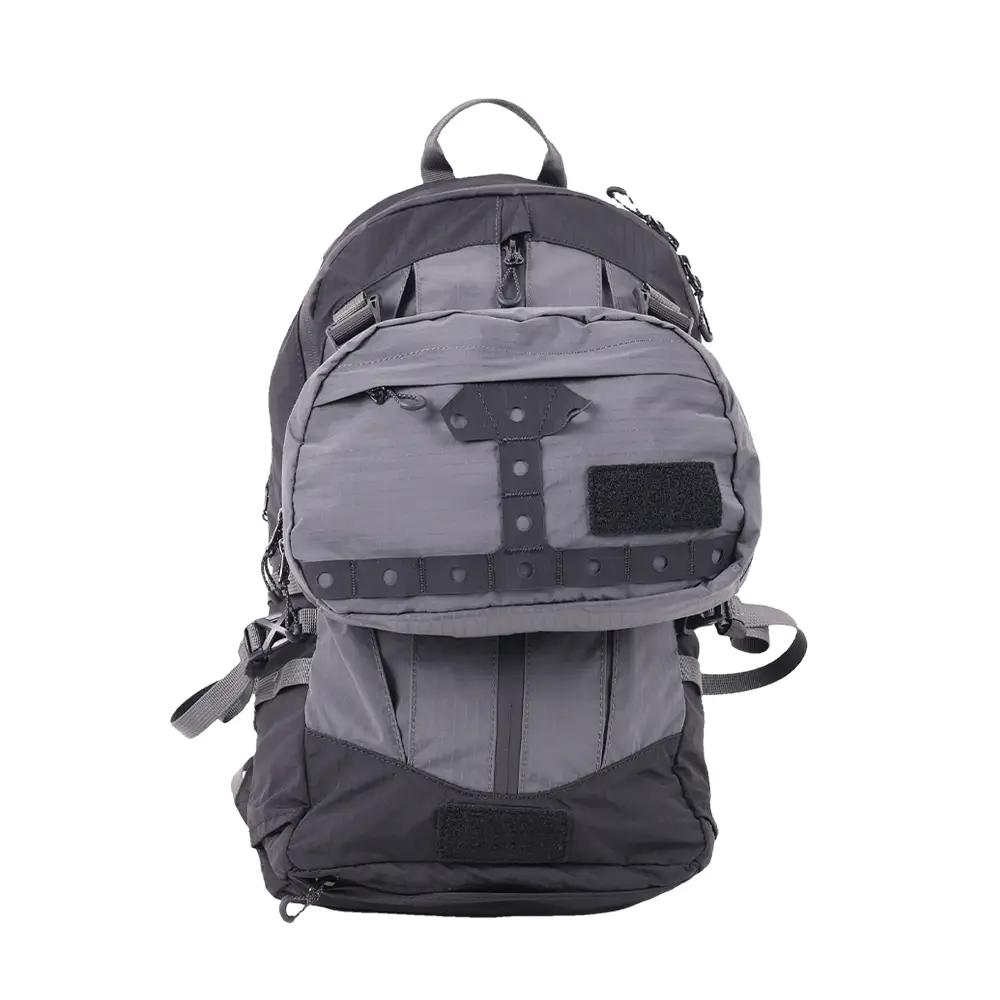
Our reference product is described as a transformable design for daily use and outdoor activities, with customizable compartments and structural options. That positioning reinforces the need to evaluate backpanel geometry against use.
What the Science Means for Bag Development
EVA molded backpanels do not reduce sweat through the material alone. Their value comes from geometry: raised support zones create separation, while recessed channels can preserve pathways for heat and moisture exchange. Research supports the thermal-comfort principle, but real-world performance still depends on the complete backpack system.
When building a private-label product, it’s important for companies to consider the user, load, activity, and climate. Then, design the panel accordingly and verify that it meets the approved material, geometry, and assembly requirements. Because the backpanel’s ability to maintain open, supportive, and functional channels is crucial to the bag’s overall performance, we at ChangRong consider it an integral component.