Cycling changes the way a shoulder bag behaves. Pedaling creates repeated body movement, while braking, cornering, and leaning can make a single-strap bag rotate away from the back. That movement can interfere with access, balance, and concentration. For buyers developing or sourcing cycling-oriented bags, the underarm stabilizer is therefore a functional construction detail rather than decorative hardware.
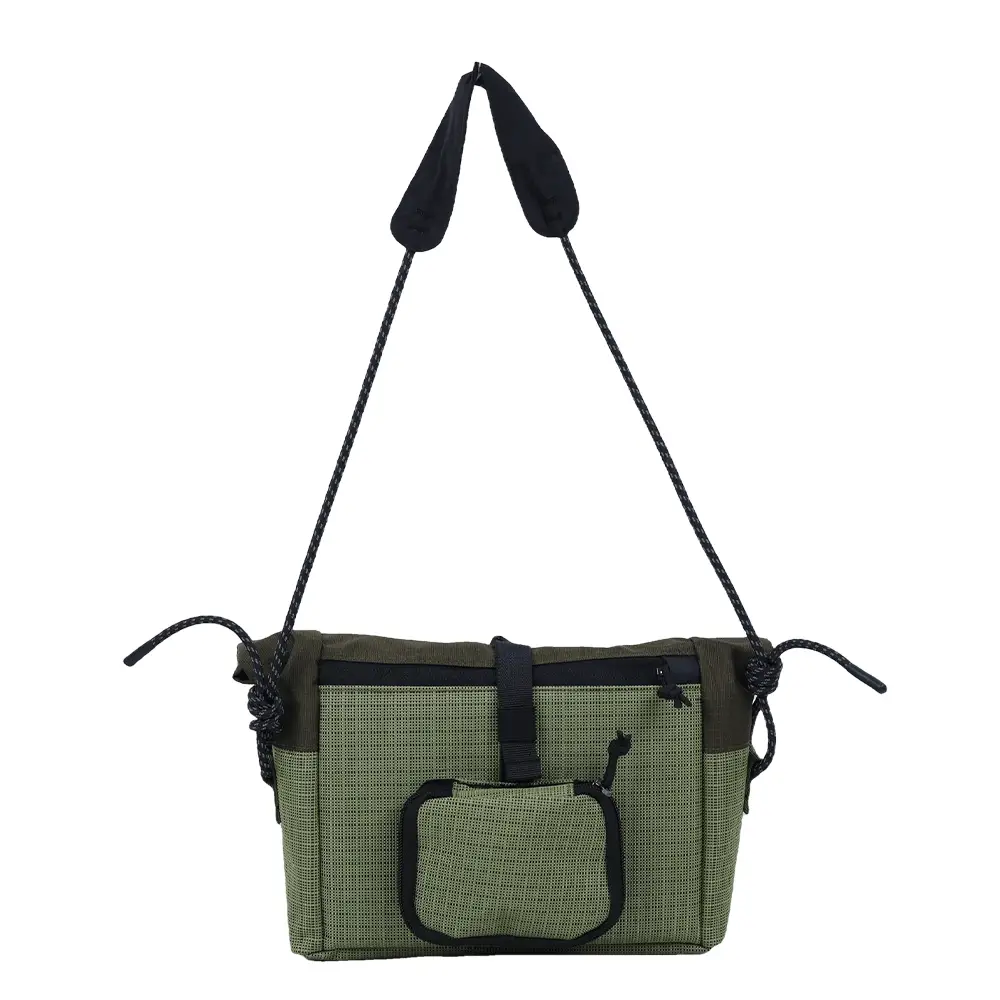
Why the Main Shoulder Strap Alone Can Shift
A conventional crossbody design depends on one diagonal strap to support the bag and control its position. Walking produces relatively predictable movement, so slight movement may not be troublesome. Cycling is different because the rider continuously changes torso angle and leg motion.
During pedaling, the bag can swing toward the front or side of the body. Cyclists frequently describe this rotation as a problem, while established bag makers position stabilizer straps as a way to keep messenger bags close during riding.
The issue becomes more noticeable when dense items shift inside the compartment. Once the load moves away from the rider’s back, the main strap must control both weight and rotation.
How an Underarm Strap Changes the Load Path
A stabilizer underarm strap adds a second point of restraint. Instead of allowing the bag to pivot mainly around the shoulder strap, the secondary connection limits that rotation and keeps the bag closer to the rider.
The primary strap carries the bag across the torso, while the stabilizer connects it to the bag at another point. Manufacturers describe this arrangement as preventing swinging during cycling.
That extra restraint is particularly useful for crossbody messenger bags for men intended for commuting or active urban travel. The rider retains messenger-style side access without accepting the same movement as a basic shoulder bag.
For an OEM project, the attachment location deserves attention. A stabilizer that is too low may fail to control rotation effectively; one positioned without enough adjustment may pull awkwardly against the torso. We would evaluate the connection points together with strap routing, buckle position, and the intended wearing side.
What Should Be Designed Into the Strap
An underarm stabilizer does not need to be complicated, but it needs usable adjustment. Riders have different torso sizes, clothing layers, and preferred bag positions. Adjustable stabilizer straps are therefore common in cycling-oriented messenger designs. WaterField specifies adjustable length on its cycling strap, while Chrome’s stabilizer is also designed as an adjustable removable component.
Hardware should match the intended use. The strap needs a secure connection and a buckle that can be released easily. Attachment points should be reinforced because the stabilizer repeatedly transfers movement into the bag body.
Placement matters as much as hardware. The strap should pass under the arm without creating an unnecessarily restrictive fit. A well-designed system should stabilize the bag while allowing normal shoulder and arm movement. That is why we treat the stabilizer as part of the carrying system rather than an accessory added at the final production stage.
What This Means for OEM and ODM Development
For a factory developing a men’s crossbody messenger bag, the stabilizer should be specified during pattern and sample development. Adding a strap after the main bag has been finalized can leave attachment points poorly positioned or insufficiently reinforced.
Our development process starts with the intended cycling scenario: commuting, urban riding, or more active use. That decision affects strap length, attachment geometry, hardware, and adjustability. A bag intended mainly for walking may need only a removable stabilizer, while a cycling-focused model can integrate dedicated anchor points from the beginning.
Prototype testing should focus on movement rather than appearance alone. We would check whether the bag rotates forward, whether the stabilizer remains comfortable under the arm, whether the buckle stays accessible, and whether loaded and lightly loaded bags behave differently. A practical design should work in the actual wearing position rather than only look secure on a product sample.
Our outdoor and travel bag construction experience also makes the attachment zone worth examining. Webbing ends, bartacks, reinforcement layers, and seam placement affect how the secondary strap transfers force into the bag body. Construction should follow the project’s materials and load requirements rather than one universal specification.
When the Feature Is Worth Making Standard
Not every crossbody bag needs a stabilizer. A small bag used mainly for walking may not justify additional hardware. The case becomes stronger when cycling is an explicit use scenario, particularly for commuting or active mobility.
When comparing men’s crossbody messenger bags, the key issue is stabilization. Check the attachment points, adjustment range, removability, and comfort when tightened to see if the feature was genuinely engineered for motion or just added to a spec sheet.
Integrating Stabilization Into Bag Development
A cycling-oriented men’s crossbody messenger bag should keep its load controlled without sacrificing the access and convenience that make the format attractive. The underarm stabilizer provides restraint between those goals.
When we develop such a feature at ChangRong, we view it as part of the bag’s movement-control system: its value comes from coordinated strap geometry, attachment strength, adjustment, and real-use testing.