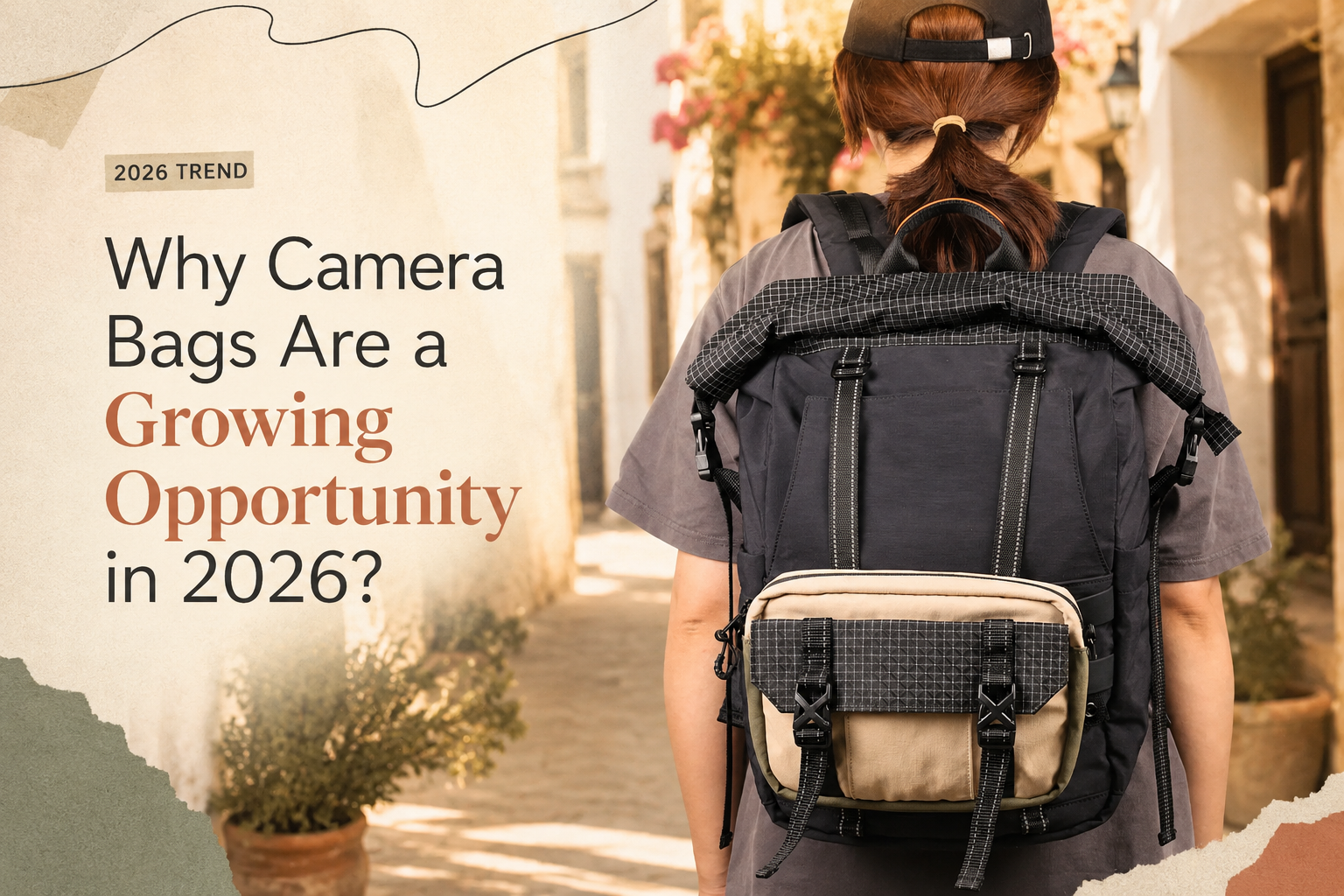
A top zipper is convenient for quickly reaching a camera, lens, or accessory, but its exposed position can also become a weak point during wet-weather use. Designing a weatherproof flap is therefore not simply a matter of adding a strip of fabric above the zipper. We need to control the path rainwater takes toward the opening while keeping the zipper easy to operate.
For a bag for camera equipment, that balance becomes especially important because the top opening is frequently used. Our design process starts with the zipper itself and works outward, rather than treating the flap as an independent decorative component.
The Top Zipper Needs Protection From More Than Direct Rain
Direct rainfall is only one part of the problem. Water can land on the upper surface, move toward the zipper, and collect along the junction between two panels. A flap must therefore interrupt the route water would naturally follow toward the zipper teeth.
We first examine the zipper’s position relative to the surrounding shell. A zipper located on a curved or slightly raised top panel can require a different flap shape from one positioned on a flatter surface. The surrounding pattern determines how easily water can move toward the opening.
The flap should create a covered zone over the zipper rather than merely sit directly on top of it. That distinction matters because a narrow cover can leave exposed sections at the ends or allow water to approach from the sides.
Flap Width Should Follow the Zipper’s Exposure Zone
Flap width should be determined by the area that actually needs shielding. Making the flap unnecessarily wide adds bulk and can interfere with handling, while making it too narrow creates exposed sections along the zipper.
We map the zipper line first, including its ends and the areas where the zipper changes direction. The flap then needs enough lateral coverage to protect those exposed zones. Curved zipper layouts may require the flap to follow the same geometry instead of remaining completely straight.
A bag for camera equipment also needs practical access around the protected opening. The flap should cover the zipper without extending so far into the opening that the user has to fight the fabric every time the bag is opened.
The Flap Edge Determines Whether Water Gets a Clear Path In
The lower edge of the flap is where the weatherproofing concept becomes a physical construction. If the edge collapses, curls upward, or leaves inconsistent gaps, water may find a direct route toward the zipper.
We pay particular attention to how the edge behaves across the entire zipper length. A flap that sits correctly in the center but lifts at the corners does not provide consistent coverage.
Edge construction also needs to work with the bag’s shell. Stitching, seam placement, binding, and reinforcement should be considered together so that the flap remains stable without creating unnecessary thickness around the opening.
Zipper Access Has to Be Designed Into the Flap
A weatherproof flap becomes counterproductive if photographers must move it awkwardly before they can reach the zipper. Protection and accessibility should therefore be developed together.
The zipper pull needs sufficient clearance to travel its complete path. We check where fingers naturally approach the puller and whether the flap catches against it during opening. The flap’s attachment position can also affect how far it can be lifted.
For a custom camera bag, we would test the flap with the actual zipper and intended shell materials rather than evaluating it from a flat pattern alone. Material stiffness, padding, and seam thickness can all change the way the cover behaves.
Our photography bag demonstrates a functional approach to camera-bag organization, with multiple pockets and a practical structure. That type of layout reinforces why zipper protection should remain compatible with fast access to the bag’s storage areas.
Opening the Bag Changes the Flap Geometry
The overlooked part of flap design is movement. A closed bag presents one geometry; an opened bag presents another. Once the zipper starts moving, the flap folds, lifts, or shifts, changing the relationship between the cover and the zipper.
We therefore inspect at least two positions during sampling. The closed position shows whether the zipper receives continuous coverage. The fully opened position shows whether the flap folds naturally and stays out of the user’s working area.
Partial opening is worth checking too. Photographers may open a top zipper only far enough to retrieve one item. A flap that behaves well only when completely open can still become inconvenient during normal use.
A Sample Should Prove Coverage Before Production
A drawing can specify flap dimensions, but it cannot fully predict how the finished construction will behave. Sampling gives us an opportunity to examine the actual relationship between fabric, zipper, seams, and flap movement.
During sample evaluation, we look for exposed zipper sections, lifted edges, excessive overlap, interference with the puller, and unwanted folding. If the intended product requires a particular level of weather resistance, the corresponding test conditions should also be defined before mass production.
The sample should use the same basic construction intended for production. Substituting a much thinner fabric or different zipper can make an apparently successful prototype misleading.
Turn the Flap Design Into a Repeatable Manufacturing Detail
Once the flap works physically, its design needs to become clear production information. We document its finished dimensions, position relative to the zipper, overlap area, edge construction, attachment method, and reinforcement points.
For a custom camera bag, these details should be incorporated into the complete pattern rather than added after the main bag has already been finalized. Changes to padding, lining, or top-panel shape can otherwise alter the flap’s final position.
At ChangRong, we treat this type of feature as part of the product’s construction logic. A buyer can specify the desired zipper location and weather-protection concept, then work through the sample stage to refine the physical dimensions and construction.
Protect the Zipper Without Creating a Barrier
An expertly engineered weatherproof flap does far more than just shield a zipper; it carefully balances rainwater deflection, structural coverage, zipper mechanics, and how the bag’s profile flexes under load.
Our workflow begins by mapping the zipper’s vulnerability zone, molding the flap to fit that specific area, optimizing edge compliance, and finally verifying smooth opening performance. This systematic sequence ensures the protective element remains strictly aligned with its core function.