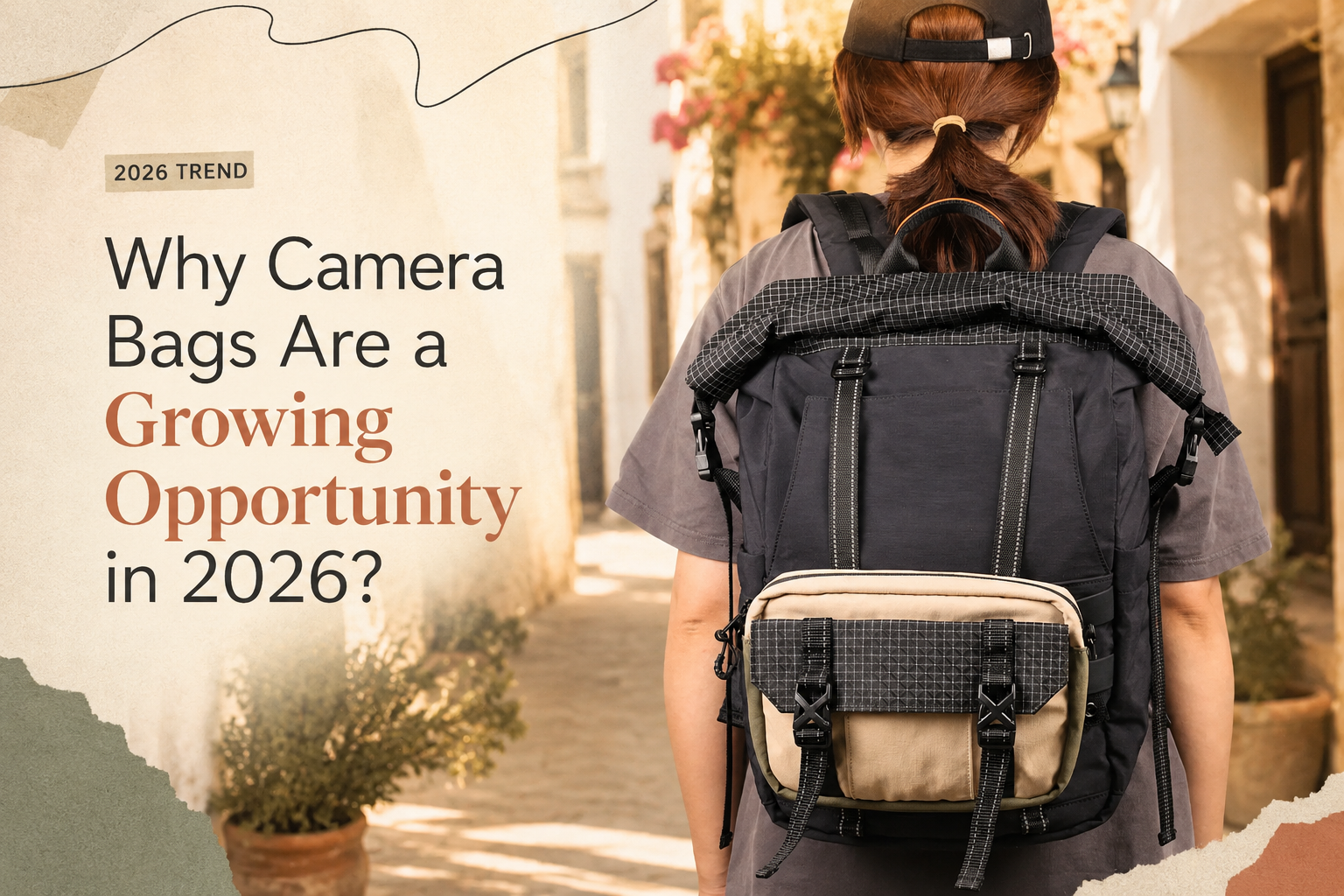
A camera carried through city streets encounters a different kind of risk from equipment stored in a studio. A shoulder bag can brush against walls, chairs, railings, and crowded surfaces while its contents shift as the photographer walks.
For a mirrorless kit, corner protection deserves particular attention because the bag’s outer edges can receive concentrated contact before the internal padding has time to distribute the force. We design reinforced corners as part of the bag’s structure, not as an afterthought added to an otherwise finished shell.
Put the Reinforcement Where Urban Contact Actually Happens
Corner reinforcement should follow the bag’s movement pattern. A shoulder bag carried across the body can rotate when the wearer turns, sits, reaches, or removes the camera. Those movements expose lower corners and side transitions to incidental knocks that a flat front panel may not experience.
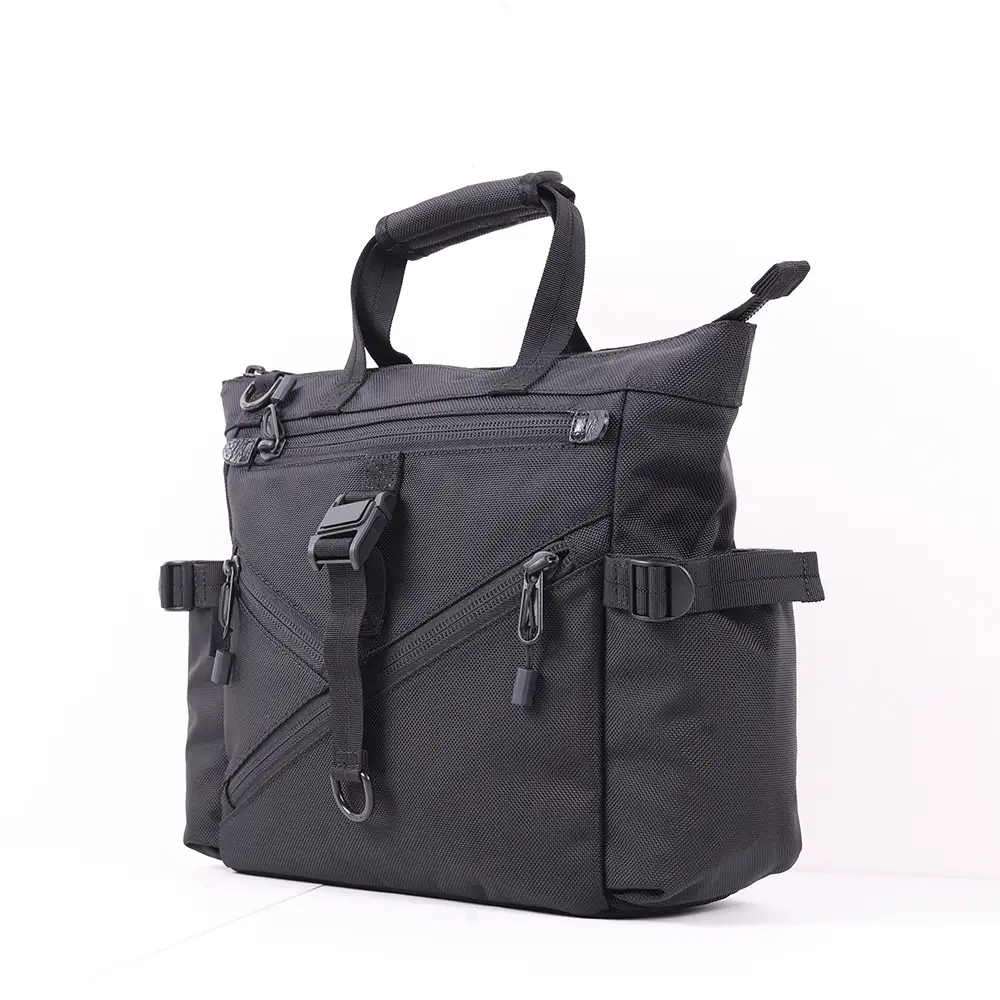
Our multi-pocket photography bag measures 31.5 × 12.5 × 32 cm and is designed for photography and daily use. Its functional-transform construction and adjustable structure require reinforcement to be integrated with the overall bag geometry rather than simply increasing the thickness of every panel.
A mirrorless camera shoulder bag also benefits from protection that remains compact. Urban photographers often need quick access and mobility, so adding excessive bulk around every edge can make the product harder to carry. The objective is targeted reinforcement: identify likely impact points, then strengthen those areas without turning the entire bag into a rigid case.
Shape the Corner Pad Around the Load Path
A corner pad works well when it connects the outer shell to the internal protective structure. If reinforcement is isolated in a small patch, impact can still travel directly into the compartment. We instead consider how the corner, side wall, base, foam, and divider meet.
Camera protection products commonly combine foam with reinforced structural layers or padded dividers. For example, camera inserts can use EVA foam and rigid board to absorb impact while adjustable dividers keep equipment positioned inside the compartment.
For a custom camera bag, the same principle can be translated into a softer, more flexible construction. A shaped foam piece can sit behind a reinforced exterior corner, while an internal divider helps prevent the camera from moving directly toward that point. The reinforcement should therefore be treated as a system of connected layers rather than a decorative exterior patch.
Keep the Protective Zone Separate From Storage Features
Multi-pocket construction creates another design challenge. External pockets, zippers, and seams can interrupt the continuous structure around a corner. If a pocket opening finishes too close to a reinforced edge, the reinforcement may become difficult to sew consistently or may reduce usable storage.
The product uses multiple pockets to organize cameras and accessories, so corner protection should be coordinated with those storage zones rather than applied afterward.
We normally define the protected perimeter before finalizing pocket positions. The corner pad can then occupy a controlled area, while pockets remain accessible outside the main impact path. This approach preserves the practical storage purpose of the bag without sacrificing the structural role of the reinforced edge.
Use Layer Changes Instead of Making Every Panel Thick
Urban protection does not require the whole bag to become heavy. Different areas can perform different jobs: the shell resists abrasion, foam cushions impact, internal dividers stabilize equipment, and reinforced corners handle concentrated contact.
Commercial camera bags demonstrate this layered approach. Lowepro, for example, uses padded protection and adjustable dividers in shoulder bags designed for mirrorless equipment, while other protective camera cases combine impact-resistant shells with foam or padded internal structures.
For a mirrorless camera shoulder bag, a carefully shaped corner insert can therefore provide more useful protection than simply increasing foam thickness across every surface. The design should preserve the bag’s carrying profile while giving vulnerable edges a higher level of structural support.
Validate Corners Under Repeated Everyday Movement
A corner that survives a single controlled impact may still fail after repeated handling. We test reinforced samples through realistic movements: carrying the loaded bag, setting it down, rotating it against the hip, placing it beside furniture, and moving through narrow spaces.
The test should examine more than visible damage. We check whether the corner remains aligned, whether stitching pulls away from the reinforcement, whether foam migrates, and whether internal dividers continue to hold the equipment away from the shell. Protection is only useful if the construction remains stable after repeated use.
Load testing also matters because the bag’s weight changes the force reaching the corner. A sample that looks adequate when empty can behave differently once a camera body, lens, batteries, and accessories are inside. Testing should therefore use a representative load rather than relying only on an unloaded prototype.
Convert the Reinforced Corner Into a Production Specification
Once the corner design is validated, we document its construction in measurable terms. The specification should identify reinforcement material, thickness, shape, placement, seam allowance, stitch path, foam relationship, and the point where the protective layer transitions into the standard shell.
Instead of being a one-off sample feature, a reinforced-corner idea may be included into an OEM specification with ChangRong’s assistance for colour, logo, fabric, and structure customisation.
Balance Protection With the Bag’s Overall Construction
Protecting the equipment, keeping the bag mobile in urban areas, and being feasible to produce are the three needs that ChangRong discovers that a robust corner design eventually balances.
Coordinating with cushioning, dividers, seams, and storage geometry, reinforcement works best when it mimics the actual path of impact. Making a bespoke camera bag more durable without sacrificing the adaptability that makes shoulder carry practical for everyday photography is possible by placing protection where it is most likely to be needed.