Water protection on a camera sling is not simply a question of adding a “waterproof” finish. DWR and polyurethane (PU) coatings address moisture in different ways. One primarily changes how water interacts with the textile surface, while the other forms a polymer coating on the fabric. For brands developing photography sling bags, understanding that distinction makes material selection far more precise.
The First Difference: Surface Repellency vs. Fabric Barrier
DWR, or durable water repellent, is a textile finish designed to make fabric hydrophobic. EPA describes DWR as a coating or treatment added to fabrics to produce water-repellent properties, with formulations that can include silicone, fluorochemicals, and fatty materials.
PU coating works differently. Rather than primarily modifying the surface behavior of individual fibers, polyurethane can be applied as a polymer coating to the textile substrate. EPA identifies polyurethane as one of the common materials used for coated fabrics and notes its use in products including luggage.
That difference gives us the starting point for the comparison: DWR helps the exterior resist wetting, while PU can create a more substantial coated layer. Neither term, by itself, describes the complete water protection of a finished camera bag.
What DWR Contributes to a Photography Sling
DWR is particularly useful when the objective is to prevent the outer textile from becoming quickly saturated during ordinary exposure to rain or splashes. EPA distinguishes water-repellent finishes from waterproofing agents, noting that repellents are intended to prevent fabrics from becoming wet out while remaining breathable.
For a camera sling, that surface behavior can be valuable because the bag’s exterior remains easier to manage during brief wet-weather exposure. It also preserves the character of the underlying textile more directly than a heavy polymer layer may.
However, DWR should not be treated as a complete waterproof construction. An outer fabric can repel droplets while water still finds a route through seams, openings, zippers, or other construction points.
What PU Coating Changes
PU coating takes the comparison into fabric engineering rather than surface finishing alone. EPA explains that polymer coatings can enhance textile performance and that polyurethane is widely used on coated fabrics, including luggage and other products requiring protective characteristics.
The coating can provide a more substantial barrier than surface repellency alone. Its suitability depends on the substrate, coating formulation, application method, and desired finished characteristics. EPA also notes that coating selection is influenced by polymer properties and that there is no single polymer solution for every coated-fabric application.
For camera bags, this makes PU attractive when the material specification calls for stronger resistance to water penetration rather than simply reducing surface wetting.
Why Camera-Bag Construction Makes the Choice More Nuanced
Photography products introduce a requirement that ordinary bags do not have: moisture protection has to coexist with equipment protection and convenient access.
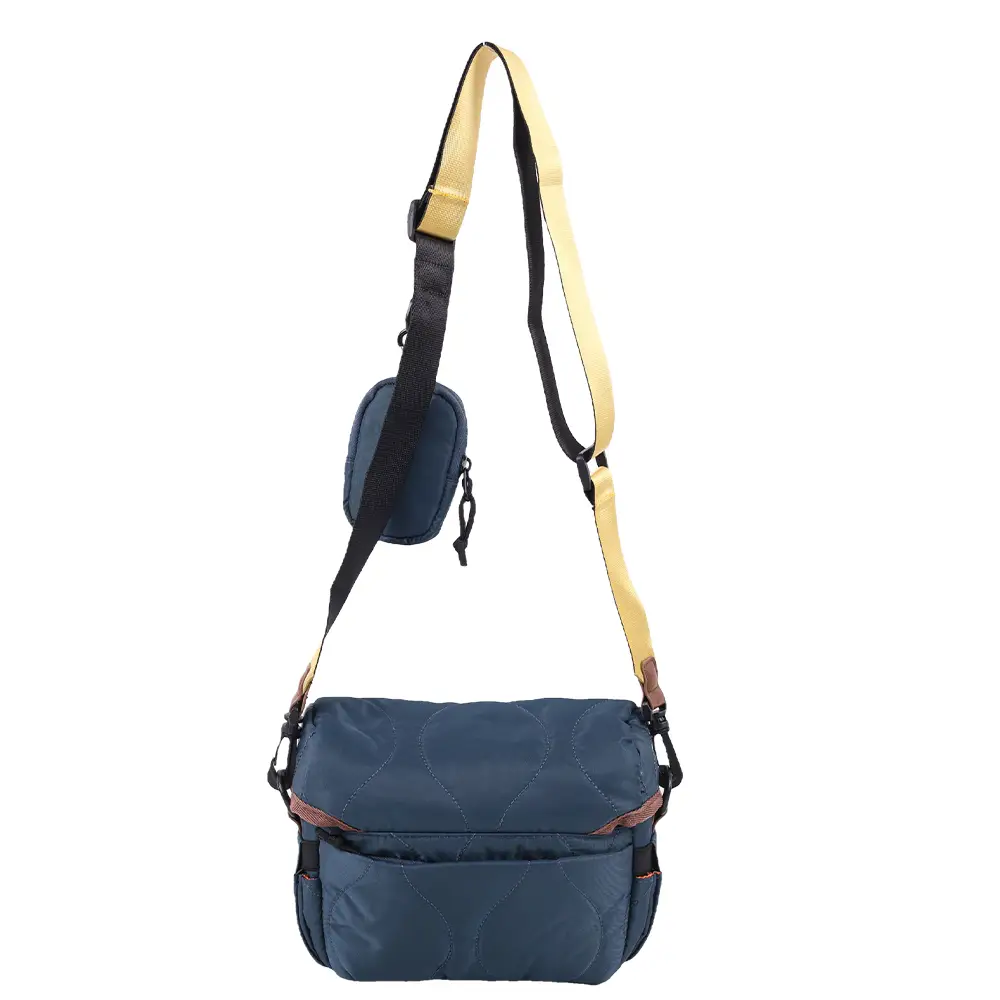
Our referenced camera bag, for example, is designed with quilted padding, quick-release buckles, adjustable straps, and a transformable format for photography, daily use, and travel. Its stated dimensions are 21 × 9.5 × 18 cm.
Those features demonstrate why coating selection cannot be separated from the complete construction. A protective material must work alongside padding, compartments, closures, and access points rather than being evaluated as an isolated fabric specification.
A highly coated textile does not automatically create a waterproof camera bag. The bag’s openings and seams remain part of the moisture pathway, so the final design must be assessed as a complete product.
Comparing DWR and PU by Real Carrying Conditions
Short exposure to drizzle or incidental splashes may favor a construction where surface repellency is the primary objective. DWR can address wetting of the outer textile without making the coating itself the dominant characteristic of the fabric.
More demanding moisture protection may call for a coated fabric construction. PU is capable of forming a protective polymer layer, making it relevant when the specification requires greater resistance to water penetration.
The choice also depends on the desired hand, flexibility, appearance, and overall construction. A photography sling intended to transition between camera carrying and everyday use may require a different material balance from a dedicated outdoor equipment case.
Consequently, the right comparison is not “Which coating is strongest?” It is “Which moisture-management approach matches the product’s actual exposure and construction?”
How We Approach Coating Selection for Custom Camera Bags
We begin with the use scenario rather than selecting a finish from a standard materials list. A brand should identify whether the bag is intended for commuting, travel, outdoor photography, or a mixture of these environments.
Next, we consider the base fabric and the rest of the construction. A nylon shell, for example, may require a different coating strategy from another textile because adhesion, flexibility, weight, and surface characteristics can affect the finished material.
ChangRong’s referenced camera-bag model uses high-quality nylon, padded construction, adjustable shoulder/crossbody carrying, and a functional transform design. The product can also be customized in areas including fabric and structure.
That flexibility is useful during OEM development because the coating should be selected as part of the material package, not added as an afterthought.
Choosing Protection Around the Camera, Not Just the Fabric
The DWR-versus-PU decision becomes much clearer once the desired protection is defined. DWR primarily manages how water behaves on the textile surface, while PU coating can create a polymer layer that contributes more directly to resistance against water penetration.
When designing photography sling bags, brands should begin by defining environmental conditions, followed by a comprehensive review of fabric treatments, seams, closures, padding, and access points. ChangRong applies this holistic methodology to camera bag development, ensuring water resistance genuinely enhances photographic utility instead of serving as a standalone marketing buzzword.