A camera sling bag has to solve two spatial problems at once. The photographer needs protected, organized storage for fragile equipment inside the bag, while the exterior may need flexible attachment points for accessories that change from one outing to another.
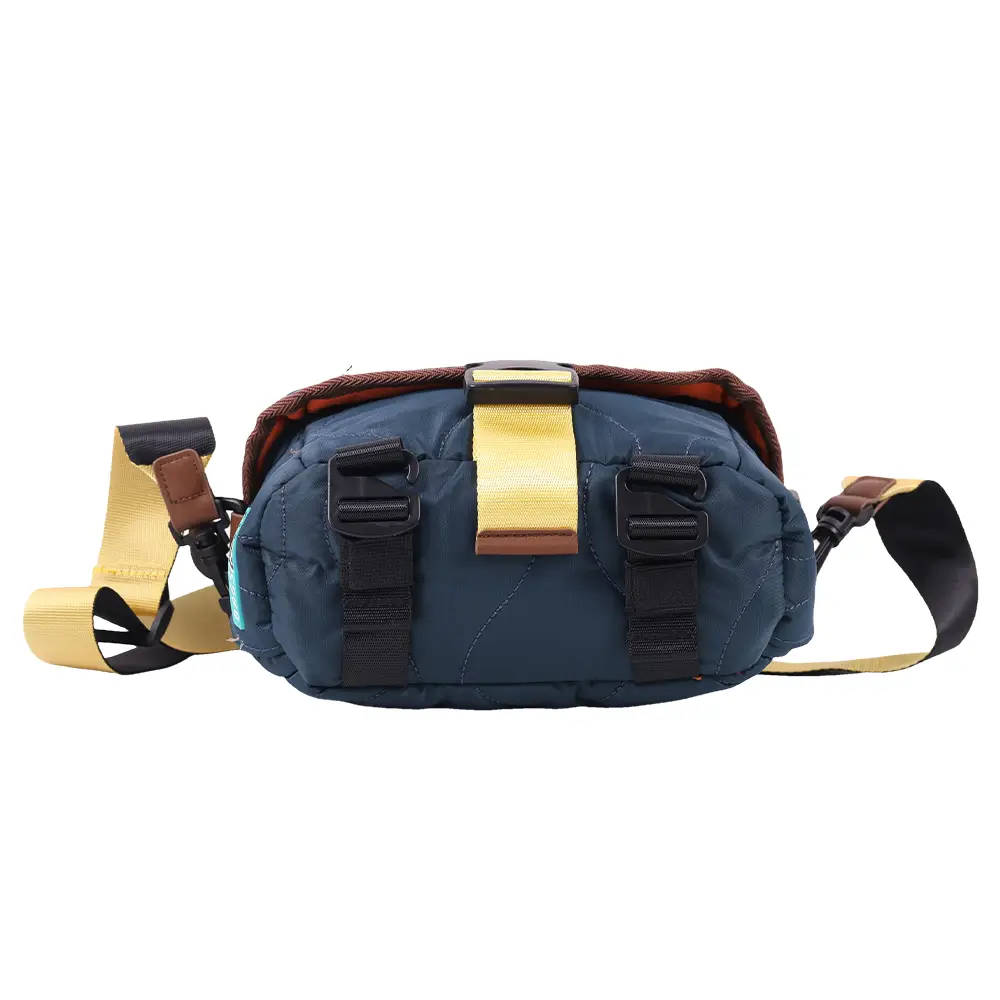
That creates a different design logic from an ordinary shoulder bag. We see the architecture as two connected layers: the interior controls and protects the camera system, while the exterior creates opportunities to expand what the bag can carry. The challenge is making those layers work together without turning a compact photography bag into an unnecessarily bulky pack.
The Outside and Inside of the Bag Solve Different Problems
A lens pouch and a MOLLE attachment should not be evaluated as interchangeable storage features. They address completely different requirements.
Inside the bag, a lens needs controlled positioning and protection from direct contact with harder equipment. Outside, an attachment system is intended to make selected accessories easier to add, remove, or reposition.
The distinction becomes especially important in a sling format. The user often rotates the bag toward the front of the body to reach equipment, so the internal organization has to remain predictable while external accessories cannot interfere with that movement.
Our CXN1154 camera bag follows this broader functional philosophy. The product is designed for photography, commuting, and travel, with padded construction, adjustable carrying, quick-release buckles, and a transformable structure.
MOLLE Webbing Creates an External Expansion Layer
MOLLE is fundamentally a modular load-carrying concept. The U.S. Army describes the system as allowing users to tailor components according to the size and placement of their loads, while its pouch attachment structure provides a way to configure compatible accessories.
For a camera sling, that concept can be adapted beyond its original military context. External webbing can provide attachment points for selected pouches or accessories, giving the user an expansion layer without requiring every storage option to be permanently sewn into the main body.
The construction needs to account for the forces introduced by those attachments. Webbing is sewn onto a supporting panel, so the load does not stop at the attachment strip; it travels through stitching and into the bag body.
That makes placement important. A modular panel positioned on a structurally weak or heavily curved area may be less practical than one supported by the bag’s main body construction.
Lens Pouches Turn Open Space Into Controlled Camera Storage
Camera equipment has different storage requirements from everyday items. A lens pouch is not simply a smaller pocket. Its purpose is to control movement and create separation around a component that the user may remove and replace repeatedly.
Padding is particularly relevant to this internal architecture. The ChangRong camera bag uses adjustable straps and quick-release buckles to support photography, commuting, and travel. The adjustment system allows users to switch between shoulder and crossbody carrying configurations according to their carrying needs.
For lens storage, the pocket opening also matters. A compartment that is secure but difficult to reach undermines the purpose of a sling bag. Photographers often need to access equipment while keeping the bag close to the body, so the pouch needs to balance retention with access.
This is where interior organization becomes part of the bag’s operating architecture rather than merely its capacity.
The Sling Structure Has to Carry Both Systems Without Fighting Them
External modularity adds potential weight away from the central body, while camera equipment already creates a concentrated internal load. The shoulder strap, attachment points, padding, and body panels therefore need to work as one carrying structure.
An adjustable strap is particularly useful in a sling design because the bag’s position changes according to whether the user is walking, shooting, commuting, or reaching for equipment. The referenced camera bag uses adjustable straps for shoulder and crossbody carrying, reinforcing the importance of adaptable positioning.
Quick-release hardware adds another interaction. The user needs to open the bag rapidly without an exterior pouch, strap, or attachment obstructing the movement.
For us at ChangRong, this is where product development moves beyond adding features. The components must be placed according to how the complete bag moves around the user’s body.
Quick Access Changes How the Compartments Should Be Arranged
Photography creates a different access rhythm from ordinary commuting. A user may carry a camera inside the main padded area, keep a lens or accessory nearby, then rotate the sling forward and reach inside.
That sequence favors compartment arrangements that can be identified by touch and accessed without completely opening the bag. The zipper direction, opening angle, pouch position, and internal dividers all contribute to that experience.
External attachments should support rather than interrupt this sequence. A modular pouch placed directly beside the primary opening may compete for hand space, while an attachment farther along the panel can remain available without obstructing the main access route.
A good architecture therefore starts with the movement of the user, not the number of pockets that can be added to the specification.
An Urban Camera Bag Needs Modularity Without Looking Like a Field Pack
Tactical-inspired construction does not require an urban photography product to reproduce a military pack visually. The useful part of modular design is configurability, not necessarily an aggressive appearance.
This distinction matters for an urban camera bag intended for commuting, photography, and travel. The CXN1154 is positioned for those multiple scenarios and combines functional construction with a men’s everyday-bag format rather than being presented solely as tactical equipment.
An exterior attachment system can therefore be integrated selectively. The designer can use modular webbing where expansion has a practical purpose while maintaining cleaner surfaces elsewhere.
That approach also gives brands more room to develop different visual identities around the same functional architecture. Color, fabric, logo placement, and structural details can be customized during product development.
The Architecture Is Proven by How the Bag Transitions Between Uses
The strong tactical camera sling is not the one with the most attachments. It is the one whose internal and external systems remain useful as the user’s situation changes.
A photographer may carry a compact camera setup on one trip and add accessories on another. The lens-storage system should continue protecting and organizing the core equipment, while the external modular layer provides additional carrying options without disrupting access.
Build the Architecture Before Adding Individual Features
Embodying this larger design philosophy, ChangRong’s functional-transform approach ensures the highlighted camera bag adapts fluidly across photography assignments, daily commutes, and travel, breaking free from single-purpose limitations.
During the OEM stage, this overarching architecture comes first—long before mapping out individual compartments and attachment loops. A true manufacturing partner needs a complete picture of internal lens security, external modular payload capacities, and smooth transitions from back to front access.
Once those interactions are dialed in, exterior gear loops and lens compartments cease to be disconnected features, instead functioning as a cohesive system built around seamless access, security, and adaptive everyday use.