An urban camera bag may spend its day under pressure that has little to do with photography. It can be placed beside a desk, squeezed into a crowded vehicle, pushed against other luggage, or pressed between objects while the photographer moves through a city. For the equipment inside, the edges and corners of the bag become important protective zones.
A private-label camera bag therefore needs more than soft padding spread evenly across its walls. Edge protection depends on how panels, cushioning, reinforcement, and internal compartments work together. We approach the problem as structural protection: the edge must resist deformation while keeping the camera and lenses separated from external pressure.
Why the Edges Become the First Weak Line Under Compression
Flat panels distribute pressure across an area, but an edge is where two or more panels meet. That transition can deform more readily when the bag is squeezed from the side or corner.
The problem becomes more pronounced when a camera bag is designed with a compact urban profile. A slimmer silhouette may be convenient to carry, but there is less unused space between the exterior and the equipment. Pressure reaching the sidewall can therefore affect the internal compartment more directly.
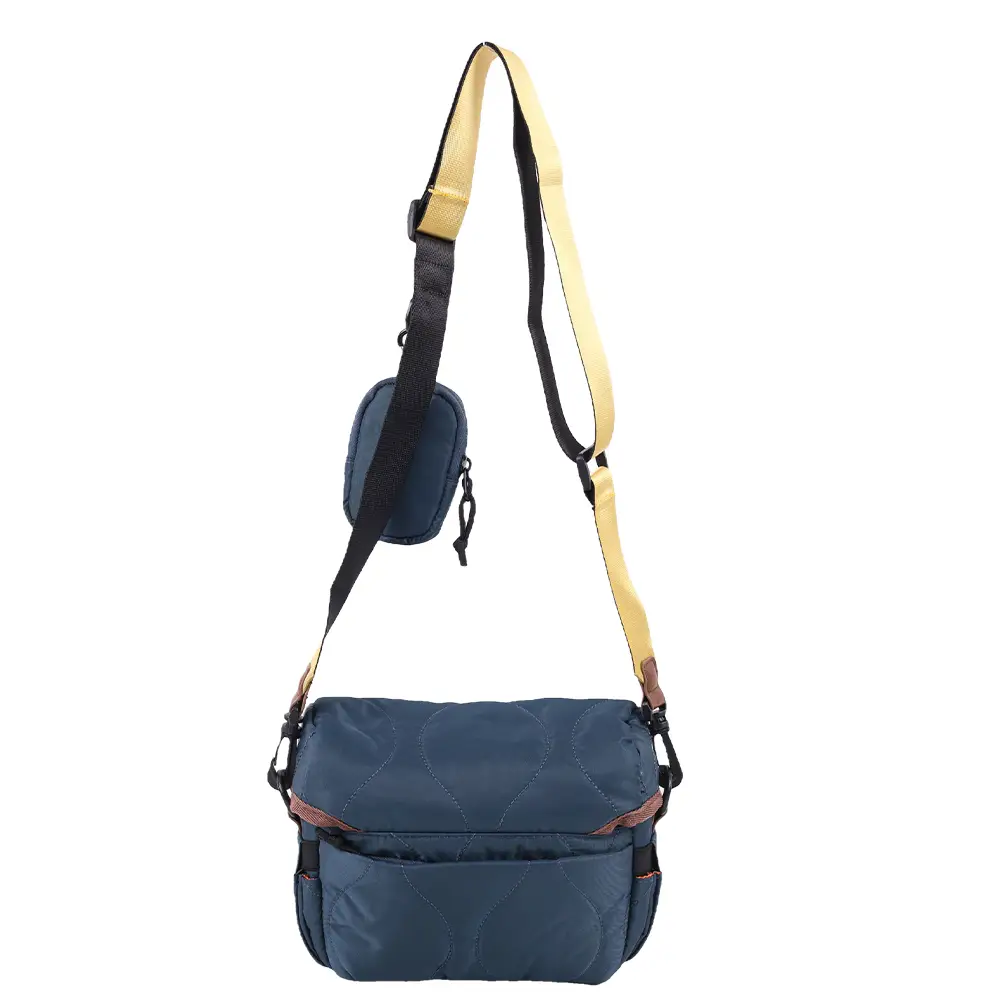
Our camera-bag reference illustrates why structural padding matters. The Functional Transform Series model is designed for photography and daily use, with a multi-pocket structure intended to organize camera equipment and accessories.
Edge engineering gives that organization another function: maintaining enough separation around the equipment when the outer shell is compressed.
What Has to Happen Inside the Edge Before It Can Resist a Crush
A protective edge normally works as a layered structure rather than as one exceptionally thick material. The outer fabric handles abrasion and everyday exposure, while cushioning helps absorb or distribute applied force. A structural layer can then help the panel resist excessive deformation.
The exact combination depends on the target product. Foam can provide cushioning, while a board or other semi-rigid element can help maintain shape. Industry camera-bag construction commonly uses combinations of foam, structural panels, and soft lining because different layers perform different jobs.
We consider the relationship between those layers when developing an urban camera bag. Simply increasing foam thickness may make the bag larger without addressing the point where an edge folds, collapses, or transfers pressure toward the equipment.
The useful question is therefore not “How much padding can fit here?” but “Which layer should control deformation at this specific edge?”
Corners Need a Different Structure From Flat Sidewalls
A corner is a change in direction, so it cannot always be engineered like a flat wall. External pressure arriving at a corner can be transferred into two adjacent panels and concentrated around the seam.
That makes corner construction particularly relevant to a private-label camera bag. A supplier may need to reinforce the seam area while retaining enough flexibility for the bag to open, close, and carry comfortably.
The internal corner also matters. If a camera or lens sits directly against a structurally weak corner, there may be little cushioning distance available when the outer shell is compressed.
We therefore look at the outer corner, seam, padding transition, and interior compartment as one zone. The goal is not to create a rigid box everywhere, but to provide greater control where the geometry naturally concentrates stress.
Padding Alone Cannot Hold the Camera Compartment in Shape
Soft cushioning absorbs and distributes force, but a completely soft construction can still collapse under sustained pressure. Once the sidewall bends inward, the available clearance around the equipment changes.
Internal organization contributes as well. Dividers do more than separate a camera from a lens; they can help keep equipment positioned away from the outer wall. A modular divider system can also adapt the protected space to different gear configurations.
For an OEM project, these elements should be developed together. A stronger wall is less useful if the internal layout allows a heavy lens to sit directly against the pressure zone.
How Edge Protection Can Preserve Access in Urban Camera Bags
Urban photographers often need access while moving rather than while standing at a workbench. Excessive reinforcement can create a stiff opening, increase bulk, or make a zipper difficult to operate.
The ChangRong camera bag is designed for photography and daily use, combining equipment protection with practical access and flexible everyday carrying.
Edge construction should therefore be coordinated with the zipper path, opening direction, handle, strap, and internal compartments. A reinforced corner that interferes with the opening may protect the bag mechanically while making the product less useful.
As part of creating new products, we ensure this equilibrium. Without compromising the usual urban handling, a private-label camera bag’s structure must convey its protective role.
Prototype Testing Shows Where the Structure Actually Gives Way
A drawing cannot fully reveal how an edge behaves once the bag is assembled. Foam compresses, fabric stretches, seams pull, and internal equipment changes the shape of the completed product.
Prototype testing should therefore focus on likely pressure zones rather than examining only the bag’s overall appearance. Load the intended camera and accessories, compress the side and corner areas, and observe whether the internal compartment retains its intended separation.
The prototype should also be opened and closed repeatedly. This reveals whether reinforcement has created excessive stiffness around the zipper or caused unwanted deformation at the opening.
Build Protection as a Layered Structural System
Our manufacturing workflow connects material selection, structural development, sampling, and production rather than treating them as independent stages. For a private-label project, that process gives the brand an opportunity to adjust the edge construction before the approved design moves into mass production.
For an urban camera bag, the well construction is therefore not necessarily the thickest one. It is the structure that protects corners and edges while preserving the compact shape, access, and carrying behavior that make the bag practical in daily use.