Choosing a sling for one mirrorless camera body and two lenses sounds straightforward until the equipment has to fit inside a padded compartment. The body may be compact, but one zoom lens can determine the depth, while the second lens changes how much usable width is needed. For us, the sizing question is therefore not simply how many liters the bag holds. It is whether the internal shape matches the actual camera kit without creating unnecessary bulk.
Why a Body and Two Lenses Are Harder to Size Than They Sound
A camera kit occupies three-dimensional space, not an abstract capacity figure. The body has its own height and depth, the attached lens extends forward, and the spare lens adds another cylindrical object that needs protection and separation.
Two photographers can therefore carry the same number of pieces but require noticeably different sling dimensions. A compact body with two small prime lenses may need a very different compartment from a larger mirrorless setup using a standard zoom and telephoto lens.
The sizing process should start with the actual equipment. We measure the body, the mounted lens, and the second lens before deciding how the internal compartment should be arranged. Current camera-sling guidance also recommends measuring the largest camera-and-lens combination and allowing additional space for padding and practical access.
That measurement-first approach prevents a common mistake: choosing a bag because its external dimensions or advertised capacity look sufficient on paper.
How Camera Body and Lens Dimensions Affect Sling Bag Depth
The camera body establishes the minimum footprint, but the longest lens often becomes the dimension that controls the compartment. A short prime can sit almost entirely within the body envelope, whereas a longer zoom requires additional depth and a suitable orientation.
Positioning also changes the result. A camera carried with its lens attached may require a longer compartment but offer faster access. Separating the lens from the body can create a more compact arrangement, although it introduces another handling step when shooting.
For a two-lens sling, we therefore consider the complete configuration rather than simply adding the dimensions of three objects. Cylindrical lenses can occupy otherwise unused corners depending on their orientation, and dividers can turn that potential space into either useful organization or wasted volume.
The objective is a layout where the equipment has defined positions without forcing the bag to become substantially larger than the kit itself.
Leave Room for Protection Without Turning the Sling Into a Shoulder Bag
Camera equipment cannot be packed against a bare shell. Padding takes up internal space, but removing it simply to achieve a smaller exterior would defeat the purpose of a dedicated camera sling.
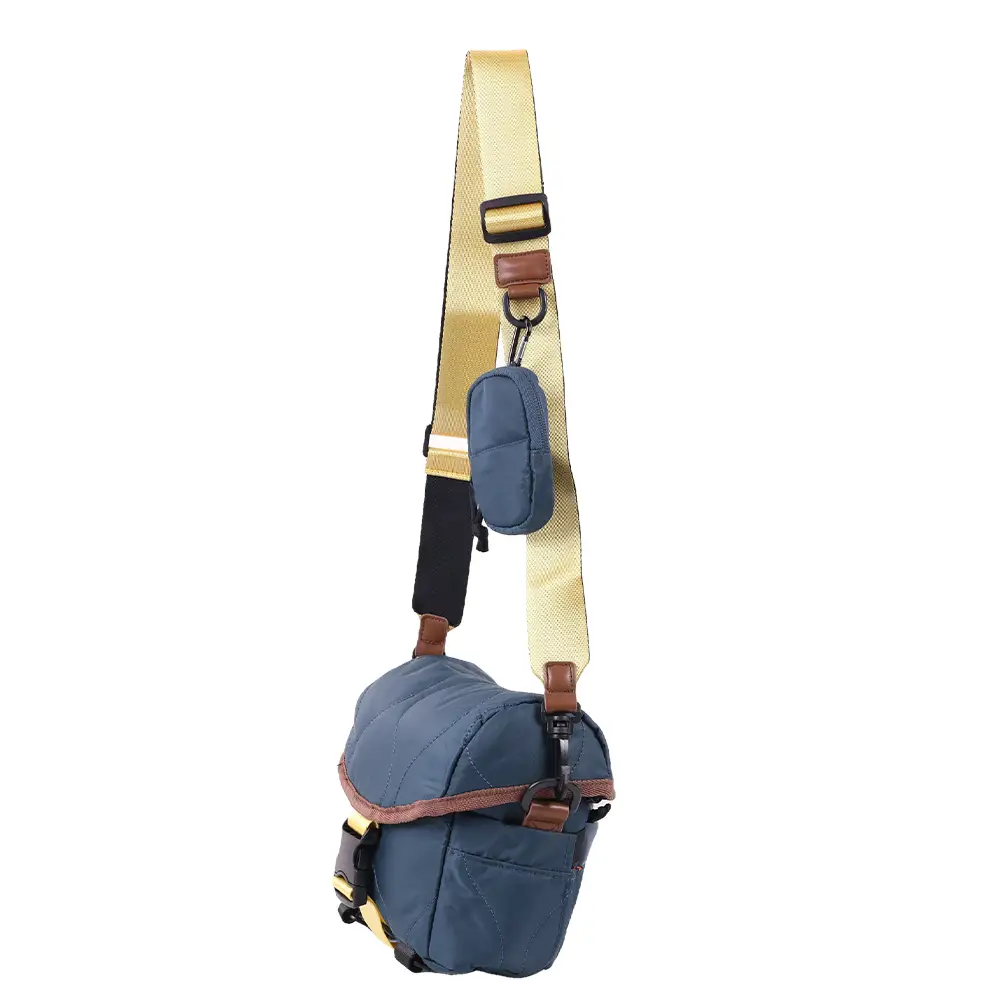
Our referenced camera sling bag design uses quilted padding to protect equipment, demonstrating the trade-off between usable storage and protective construction. The product is designed around photography while also supporting daily use and travel.
The right amount of clearance is therefore not “as tight as possible.” Equipment needs enough room to enter and leave the compartment without catching on the opening or pressing directly against neighboring gear.
Excessive empty space creates the opposite problem. A large cavity may accommodate more equipment, but a body and two lenses can move around inside it unless the internal layout controls that movement.
Why the Opening Can Matter More Than the Total Volume
A sling can theoretically contain the right amount of gear and still feel too small because the opening does not provide sufficient access.
This becomes especially noticeable with a mirrorless body that remains attached to a lens. The photographer needs to retrieve the camera through the opening rather than merely store it inside. A narrow zipper path or restricted flap can make a mathematically adequate compartment feel impractical.
Total capacity consequently tells only part of the story. A current Fstoppers guide notes that stated liter capacity describes overall volume, while padding and internal construction reduce the space actually available for camera equipment.
For two lenses, opening geometry becomes even more important because the user may need to reach the spare lens without disturbing the camera body.
What a 21 × 9.5 × 18 cm Camera Sling Tells Us
Our CXN1154 reference provides a useful real-world scale: its listed external dimensions are 21 × 9.5 × 18 cm. The structure includes quilted padding, quick-release buckles, and adjustable shoulder or crossbody carrying.
Those dimensions should not be interpreted as a universal answer for every mirrorless kit. External measurements include the shell, padding, construction allowances, hardware, and other elements that do not become direct equipment-storage space.
They do, however, show why a compact camera sling can be engineered around a focused carry rather than treated as a miniature backpack. The product’s transformable structure also indicates how the same basic form can support photography alongside daily and travel use.
For a brand developing a mirrorless camera sling bag, this distinction is valuable: the target should be a carefully shaped compartment, not simply a larger outer box.
Build the Two-Lens Layout Before Finalizing the Shell
OEM sizing works more reliably when the internal arrangement is resolved before the final shell dimensions. We would begin with a representative body and two lenses, then determine how the camera enters the bag and where the spare lens sits.
Next comes the protection layer. Padding thickness, divider placement, and lining all consume some of the theoretical internal volume. Their dimensions should therefore be included before calculating the exterior shell.
Only after those decisions should the bag’s length, height, and depth be finalized. A current camera-bag sizing guide similarly recommends matching the longest lens to the required compartment depth rather than relying on nominal capacity alone.
ChangRong’s referenced model can be customized in fabric and structure, which provides room for this inside-out development approach when a brand has a defined camera kit.
The Sweet Spot Is a Compact Fit With Deliberate Clearance
For one mirrorless body and two lenses, the ideal sling is neither the smallest possible container nor a large bag with unused capacity. The sweet spot is created by fitting the specific equipment into a protected internal layout with enough clearance for smooth access.
Current guides commonly place compact-to-medium sling capacities around the range used for mirrorless bodies with multiple lenses, but those figures should remain reference points rather than universal sizing rules.
Size the Bag From the Equipment Outward
The longest lens should be the first sizing reference, followed by the camera’s position and the location of the second lens. Once the layout is established, we can account for padding and access clearance. Working from the actual gear configuration produces a more practical result than choosing an arbitrary liter capacity and trying to fit the equipment afterward.
At ChangRong, we take a similar inside-out approach to camera-bag development. Rather than designing around a fixed exterior size, we shape the dimensions around the equipment being carried and the way the bag will be used.