A buckle can look insignificant until it is carrying a loaded camera bag. Once a photographer moves, swings, opens, and repeatedly adjusts the bag, the clip experiences more than one simple pulling force. Zinc alloy and POM offer different material characteristics, so choosing between them should begin with the intended load and testing method—not with the assumption that metal is automatically stronger than plastic.
Why Clip Material Alone Cannot Predict Bag Strength
A clip is only one link in the load path. Force passes through the buckle, webbing, stitching, reinforcement, and fabric panel before reaching the rest of the bag. If any connection is poorly designed, a stronger material at the buckle may make little difference.
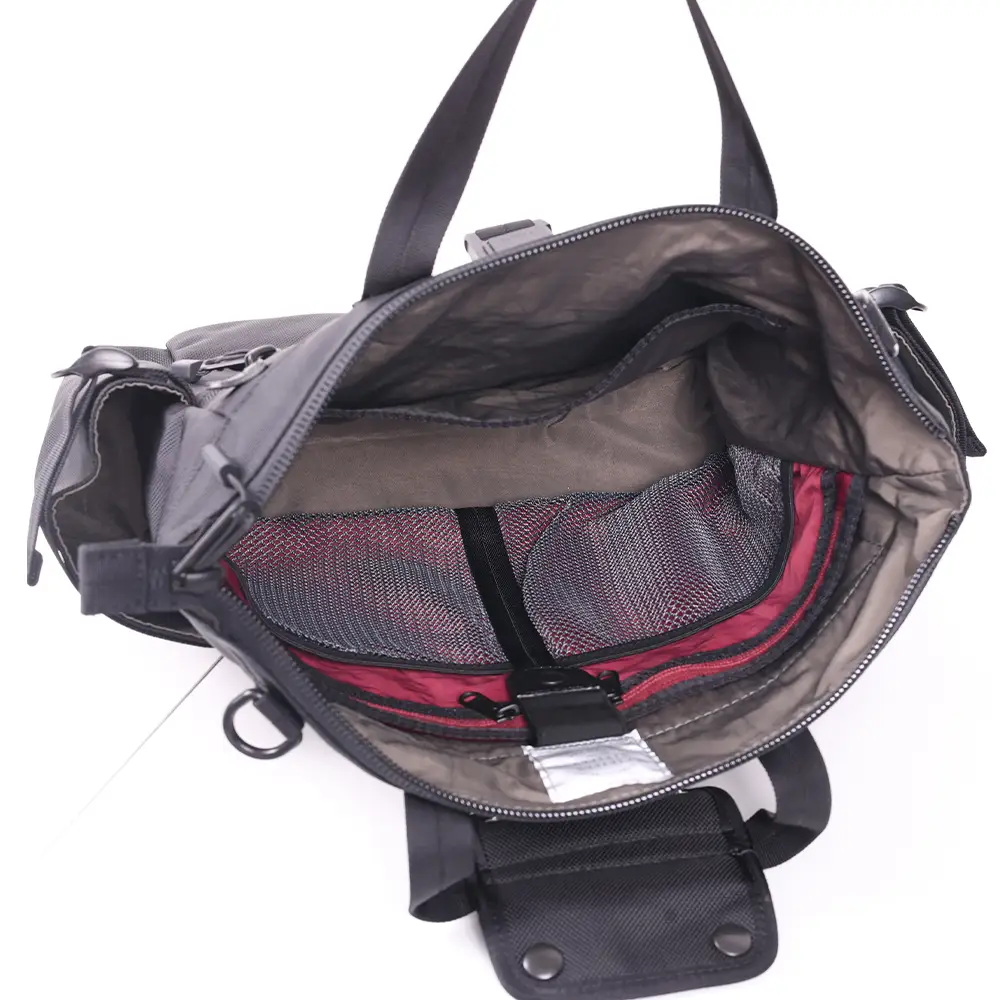
That matters particularly for a Photography Gear Bag carrying expensive equipment. Our ChangRong model uses a multi-pocket structure intended for photography equipment, with customization available for fabric and structure. The clip therefore has to be evaluated as part of the assembled product rather than as an isolated component.
A useful test starts by identifying what the hardware actually does. A main shoulder-strap buckle needs a different loading assessment from a small pocket closure because the direction, frequency, and consequence of failure are different.
What Changes When the Clip Is Zinc Alloy
Zinc is commonly used in die-cast components because it offers good castability, ductility, and impact strength. The North American Die Casting Association also notes that zinc die castings can achieve complex shapes and tight tolerances, while finished surfaces can be plated or otherwise treated.
Those characteristics can make zinc alloy attractive when a brand wants a substantial metal component with a defined appearance. Geometry still matters, however. A thin section, sharp transition, hole, gate, or other stress-concentrating feature can influence the behavior of the finished casting.
Testing should consequently use the production-intent component. We would not substitute a generic zinc buckle during development and assume its result represents the final hardware.
Where POM Performs Differently Under Load
POM, or polyoxymethylene, is an engineering polymer with high stiffness, strength, wear resistance, dimensional stability, and good impact properties. Celanese describes POM grades as offering combinations of strength, stiffness, toughness, and low moisture absorption.
The word “POM” still does not define one universal performance level. Different grades can have significantly different mechanical properties. Celanese’s technical guide, for example, reports different tensile-strength ranges among unfilled, impact-modified, and glass-reinforced grades.
Molding conditions also matter. Celanese notes that injection pressure, melt temperature, mold temperature, and other processing variables can affect the structural integrity and physical properties of molded POM parts.
For OEM development, that means the resin grade and production molding process belong in the hardware specification.
A Pull Test Is Only the Beginning
A simple tensile test can answer an important question: how much load can the assembled clip withstand before a defined failure occurs? It cannot reproduce every condition a camera bag encounters.
Repeated cycling should be considered where the buckle is opened and closed frequently. Side loading can be relevant when the strap is pulled away from the clip’s intended axis. Twisting can expose weaknesses around gates, pivots, or attachment openings.
Inspection after testing is equally useful. We look for cracking, permanent deformation, damaged webbing, distorted openings, and separation between the hardware and attachment point.
The comparison should remain controlled. If zinc alloy and POM clips use different webbing widths, stitch patterns, or anchor constructions, the resulting numbers no longer represent a clean material comparison.
Check the Webbing and Attachments Before Judging the Clip
A buckle may survive while the surrounding construction fails first. Webbing can pull through an attachment, stitching can break, or fabric can tear around a reinforced area.
That is why our test fixture should represent the actual connection used in production. The clip should be attached to the same type of webbing and reinforcement, using the intended stitching or construction method.
For a bag for camera equipment, this product-level approach is especially relevant because the hardware does not operate independently. A shoulder strap, adjustment system, and bag panel all share the load.
ChangRong evaluates the hardware as part of the finished construction rather than treating the buckle as a separate accessory.
The Camera-Bag Scenario Should Decide the Test
A compact sling carried close to the body may place different demands on a buckle from a larger camera bag that hangs from one shoulder. The amount of equipment, carrying position, strap arrangement, and frequency of adjustment all influence the test conditions we establish.
The ChangRong camera bag is designed for photography and daily use and features a multi-pocket configuration. Its design needs to balance accessibility and repeated handling with sufficient load resistance.
That is why we map out real-world scenarios before setting our test loads. Chasing impressive lab numbers means nothing if the test doesn’t reflect how the bag is actually worn and used.
How to Evaluate a Clip Before Production
Our approval process begins with the exact material specification. For zinc alloy, that means confirming the intended alloy and component design. For POM, the resin grade and molded-part design need to be controlled.
Next, we test the assembled hardware under representative loading and inspect the connection afterward. If the clip passes but the webbing or stitching fails, the construction—not simply the material—needs to be redesigned.
Evaluate the Hardware as Part of the Load Path
Finally, we compare samples from production-intent tooling and components. ChangRong uses this type of product-focused evaluation when developing customized camera bags, because the correct hardware decision depends on the complete load path.
Zinc alloy brings metal-specific mechanical and finishing characteristics, while POM offers an engineering-polymer route with its own strength, wear, and dimensional properties. The reliable choice comes from matching the material, clip geometry, attachment construction, and test conditions to the way the finished Photography Gear Bag will actually be used.